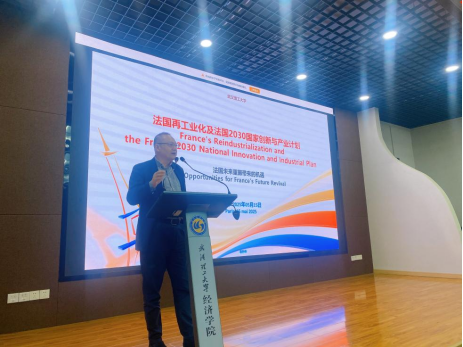
On May 15th at 2:30 PM, the 294th session of the Economics Forum was successfully convened at the Jianhu Lecture Hall. The forum featured President Shen Dai of Brest Business School (France) as the keynote speaker, who delivered an in-depth presentation titled "Interpreting France's High-Tech and AI Development Plan 2030 and Investment Strategies for Chinese Enterprises in France." The session was chaired by Associate Dean Yu Pei of the School of Economics, with over 100 faculty members and students in attendance.
Leveraging his extensive industry experience and research expertise, President Shen Dai provided a thorough interpretation of the core framework of France's "High-Tech and Artificial Intelligence Development Plan 2030." This plan aims to position France as a global leader in artificial intelligence and technological innovation. It focuses on propelling development in five key domains: Green Technologies, Quantum Computing, AI in Healthcare, Semiconductor Autonomy, and Digital Sovereignty. This will be achieved through policy support, a €30 billion funding commitment, and an industry-academia-research collaboration mechanism. President Shen emphasized, "This plan not only provides policy and financial backing for domestic French enterprises but also presents new collaborative opportunities for international technology companies, particularly those from China."
Addressing how Chinese enterprises can capitalize on opportunities in the French market, President Shen analyzed three key strategic advantages:
1.Technological Synergy: France's strengths in fundamental research areas like AI algorithms and energy technology offer significant potential for complementarity with Chinese companies' application scenarios and manufacturing capabilities.
2.Policy Incentives: Preferential policies introduced by France, such as tax credits and subsidies for innovative enterprises, can effectively reduce operational costs.
3.Geographic Access: Establishing a presence in France provides strategic access to the unified market of 27 EU countries.
President Shen also highlighted the inherent risks alongside these opportunities. Stringent EU data compliance requirements and cultural/commercial practice differences between China and France represent significant challenges requiring careful navigation.
During the interactive Q&A session, faculty and students engaged in a lively discussion on the prospects of Sino-French technological cooperation. Responding to questions on investment strategy, President Shen offered targeted recommendations. He advised enterprises to prioritize sectors with high complementarity potential, such as new energy, intelligent driving, and cloud computing. Simultaneously, he stressed the importance of actively building localized partnership networks and capitalizing on policy synergies between China and France to enhance competitiveness within the French market.
In her concluding remarks, Associate Dean Yu Pei stated that President Shen's presentation offered both macro-level policy analysis and micro-level practical advice, providing the faculty and students with cutting-edge perspectives on China-Europe science and technology innovation cooperation. She expressed the hope that more Chinese enterprises would achieve high-quality development in the global technology competition through international expansion strategies.
